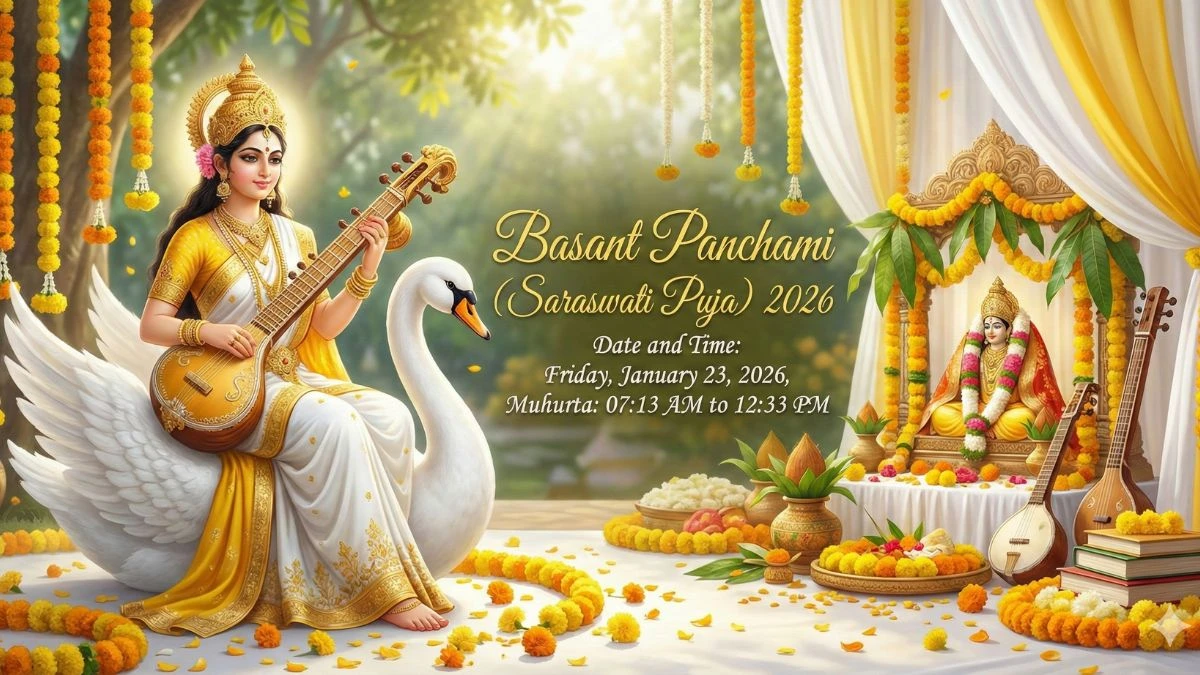

Basant Panchami (Saraswati Puja) 2026 Date and Time
Basant Panchami (Saraswati Puja) in 2026 will be celebrated on Friday, 23 January 2026. Panchami Tithi starts in the early hours at about 2:28 a.m. on 23 January and ends around 1:46 a.m. on 24 January, so the festival is observed on 23 January as per Udaya Tithi (sunrise rule).
For most people in India, that means the main puja, school functions and community events will all be planned for the Friday, with the whole day treated as auspicious for worshipping Goddess Saraswati and marking the arrival of spring.
Saraswati Puja Muhurat on Basant Panchami 2026
The main Saraswati Puja muhurat on Basant Panchami 2026 falls in the morning, roughly from 7:13 a.m. to 12:33 p.m. in North India (New Delhi reference).
This gives a comfortable window of about 5 hours, 20–36 minutes for doing the full vidhi without rushing, including sankalp, avahan, aarti and pushpanjali.
Panchang experts also note that Basant Panchami is considered an Abujh Muhurat day – meaning almost the whole day is naturally auspicious – but still recommend avoiding Rahu Kaal and keeping the main puja in the Purvahna (forenoon) period.
In many homes, the simple rule is:
-
Finish basic cleaning early.
-
Start puja after sunrise, before early afternoon.
-
Let books and instruments remain near the idol all day, even if the formal mantra part is shorter.
Saraswati Puja Rituals
On Basant Panchami 2026, Saraswati Puja rituals usually begin with bathing, wearing light or yellow-coloured clothes, and setting up a clean altar with the idol or image of Goddess Saraswati.
People place books, pens, musical instruments, art supplies, or laptops near the deity, symbolically offering their studies and creative work to the goddess for blessings.
A typical home puja often includes:
-
Kalash sthapana and a brief Ganesha puja.
-
Saraswati avahan, offering flowers, akshat (rice), incense, and diya.
-
Reciting simple mantras like “Om Aim Saraswatyai Namah” and the classic “Ya Kundendu Tushara Hara Dhavala” vandana.
-
Children writing their first letters (Vidyarambh), or students keeping books near the altar and avoiding study for a few hours as a mark of surrender.
In schools and colleges, group aartis, small cultural programs, music performances, and yellow prasad (like boondi, kesar halwa or pulav) are common, turning the day into a gentle mix of devotion and festivity rather than a very strict fast.
Basant Panchami (Saraswati Puja) History and Celebrations
Basant Panchami has its roots in the Magha month’s Shukla Panchami, traditionally marked as the symbolic beginning of spring in North India and parts of Eastern India.
Over time, this seasonal festival became closely tied with the worship of Goddess Saraswati – the deity of knowledge, music, arts, and speech – which is why many regions simply call the day “Saraswati Puja.”
Celebrations look slightly different across regions:
-
In West Bengal, Odisha and Assam, Saraswati Puja pandals, students’ group puja in schools and bright yellow decorations dominate the day.
-
In Punjab and Haryana, Basant Panchami also carries a strong “spring welcome” feel with kite flying and mustard‑field imagery.
-
In North and Central India, families quietly mark it at home, start new courses, buy books or enroll children in classes, seeing the date as a good starting point for education‑related decisions.
Even in 2026, the core idea stays the same: Basant Panchami (Saraswati Puja) is less about grand ritual pressure and more about resetting the mind towards learning, creativity and a fresh, hopeful season.
Disclaimer: Timings given here (Tithi and muhurat) are based on standard panchang references for New Delhi; local sunrise, regional calendars and traditions may vary slightly, so it is always wise to confirm exact puja time with a trusted local priest or reliable panchang app before performing rituals.