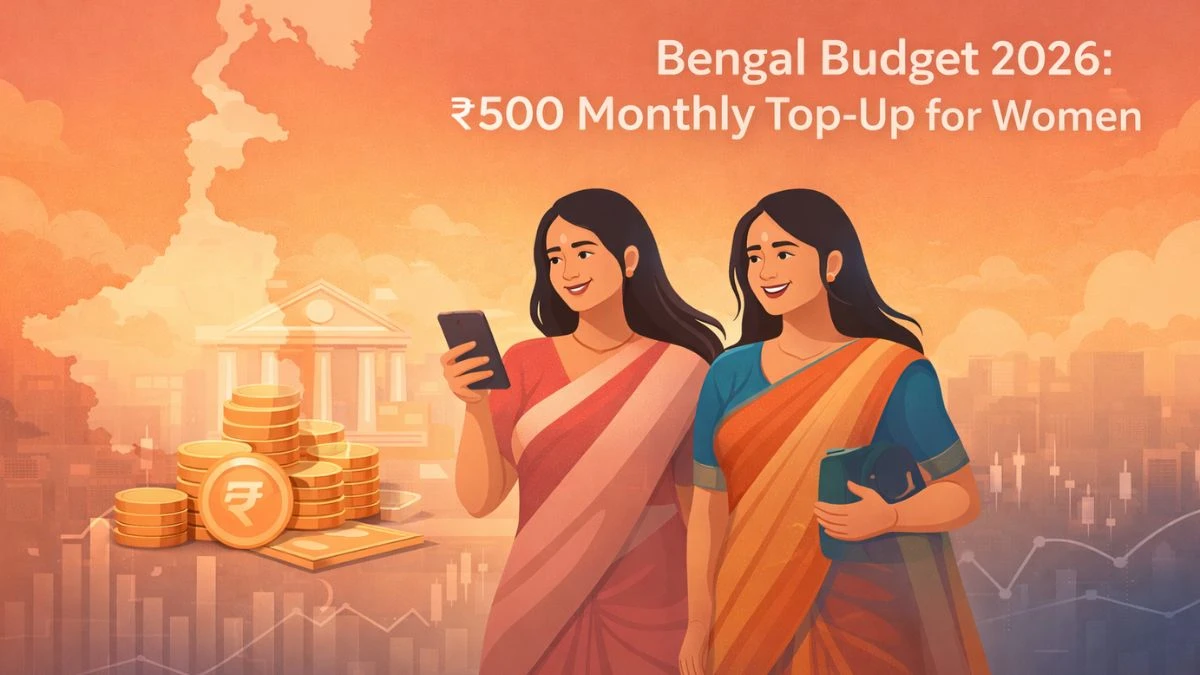

Bengal Budget 2026: ₹500 Monthly Top-Up for Women
Bengal’s 2026 interim budget has officially announced a ₹500 monthly top-up for women under the Lakshmir Bhandar scheme from February 2026.
It sounds like a small line in a long budget speech, but on the ground, it means a few extra notes in the monthly budget for over two crore women across West Bengal.
In a time when cooking oil, school fees, and basic medicines quietly become more expensive, that extra ₹500 can be the difference between “maybe next month” and “let’s just buy it now.”
The announcement came as part of a ₹4.06 lakh crore interim budget for 2026–27, clearly framed as a welfare-heavy, election-season move.
Finance Minister Chandrima Bhattacharya placed women at the heart of the speech, linking the Lakshmir Bhandar hike to dignity and financial security for ordinary households. It’s the kind of poicy tweak that doesn’t sound flashy on paper, but shows up quietly in grocery bags and school tiffins.
How Much Do Women Get Now Under Lakshmir Bhandar?
After the ₹500 Lakshmir Bhandar top-up, general category women are set to receive ₹1,500 per month, while SC/ST women will get ₹1,700 per month from February 2026.
Earlier, the scheme offered ₹1,000 to general category women and ₹1,200 to SC/ST beneficiaries, so this is a fairly substantial jump in one go. For many families, that’s almost half a cylinder of LPG, a month of tuition fees, or a medical bill that doesn’t have to be postponed.
@Ayush_Shah_25 shared on X that the Bengal Budget FY27 has revised the Lakshmir Bhandar scheme, increasing the amount for SC-ST from ₹1200 to ₹1700 per month, and for others from ₹1000 to ₹1500 per month.
Local Bengali reports describing the change talk about women using this money for “chhoto khoroch” – the small, everyday expenses that never make it into official budget documents but define real life.
In one neighbourhood story that keeps coming up, a homemaker in Howrah had been saving a slice of her Lakshmir Bhandar amount each month to buy a second-hand smartphone for her daughter’s college classes; the extra ₹500 simply means the savings target gets hit sooner instead of “maybe next Puja.”
It’s mundane, but that’s the point: this scheme was always built to support ordinary, boring, necessary expenses.
Why This Top-up Matters in Bengal’s 2026 Budget?
The ₹500 monthly increase under Lakshmir Bhandar is not just a welfare tweak; it’s clearly a political and economic signal ahead of the 2026 Assembly elections.
The state government has consistently pitched the scheme as a cornerstone of women’s economic empowerment, and this budget doubles down on that narrative by increasing direct cash support instead of introducing something completely new.
With around 2.2–2.4 crore women linked to the programme, even a modest hike creates a very visible ripple in household finances and, inevitably, in electoral calculations.
At the same time, the budget bundles this Lakshmir Bhandar top-up with other welfare moves – a 4% DA hike for state employees, higher honorariums for ASHA and Anganwadi workers, and a ₹1,500 monthly allowance for unemployed youth. Put together, it paints a picture of a government trying to say, “Yes, prices are rising, but the state is not looking away.”
Whether that is enough in the face of inflation and job worries is a longer conversation, but for now, the message is clear: the Lakshmir Bhandar scheme remains a central pillar of Bengal’s welfare politics, and the extra ₹500 is a deliberate push to keep women at the centre of that story.
Disclaimer
This content is for general informational purposes and should not be treated as official government notice or financial advice. Scheme rules, amounts, and start dates may change through new circulars or budget revisions. Readers should cross-check all details with official West Bengal government sources or gazette notifications before making decisions.