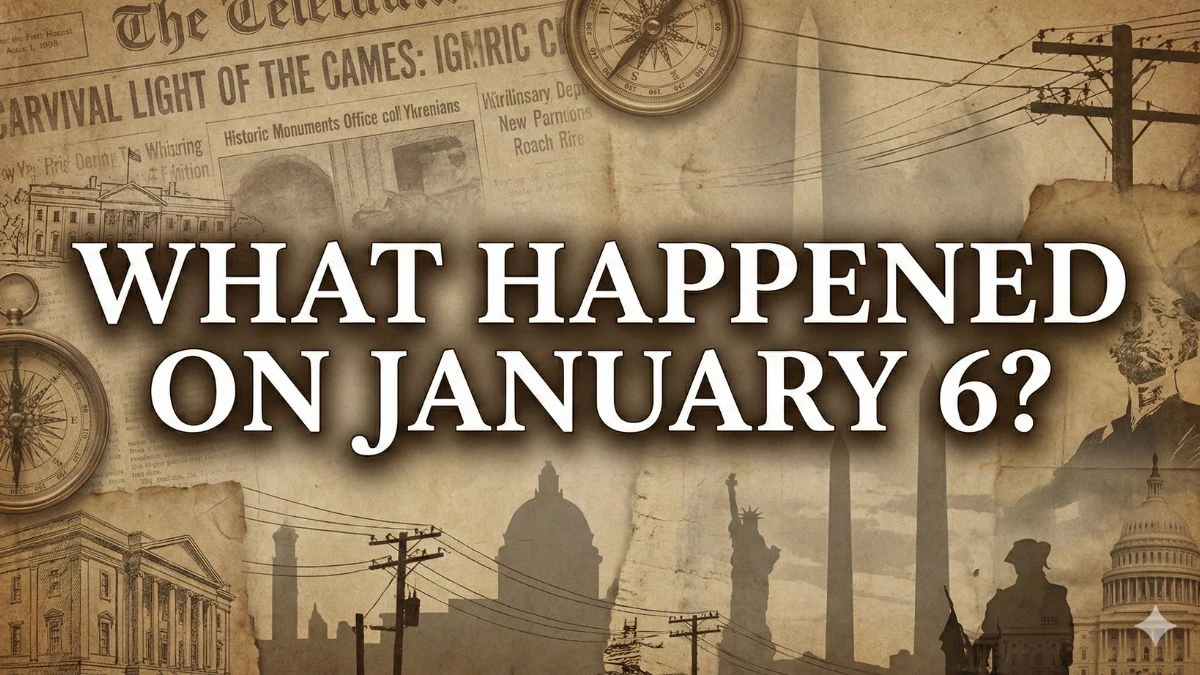

January 6 holds a distinct place in the calendar as more than just the sixth day of the year. In the Gregorian system, it arrives with 359 days still ahead 360 in a leap year yet its historical weight often makes it feel far bigger than its position suggests.
Across different eras and regions, January 6 has repeatedly surfaced at moments tied to politics, wars, technology, religion, and even modern breaking news that continues to shape public conversation.
It is also linked to festivals and observances in several countries, ensuring the date returns to headlines and social media timelines year after year.
What makes January 6 especially striking is how often it aligns with power shifts and bold decisions. From medieval coronations to parliamentary votes and presidential certifications, actions taken on this day have influenced laws, borders, and the evolving idea of democracy.
Together, these moments give January 6 a reputation as a date that highlights how loud, dramatic, and fragile history can be.
What Happened On This Day in History – January 6
Major Historical Events on January 6
1066 – Harold Godwinson becomes King of England
-
Harold II is crowned King of England after the death of Edward the Confessor, in Westminster Abbey.
-
His short reign ends later in 1066 at the Battle of Hastings, clearing the way for William the Conqueror and the Norman rule of England.
-
This shift changes English politics, language, and culture for centuries, and still appears in school history books and popular culture.
1838 – The electric telegraph is demonstrated
-
Alfred Vail and Samuel Morse publicly demonstrate an electric telegraph system using dots and dashes, a key step toward Morse code.
-
The demonstration shows that messages can travel long distances faster than any messenger on horseback or ship.
-
This single idea eventually leads to global communication networks, and in a way, it is an early ancestor of instant messaging and live news alerts.
1912 – New Mexico becomes a U.S. state
-
On January 6, 1912, New Mexico is admitted as the 47th state of the United States.
-
This closes a long chapter of territorial status and brings new political representation in Congress.
-
The change also speeds up development in the region, from infrastructure to education and energy projects.
1941 – Franklin D. Roosevelt’s “Four Freedoms” speech
-
U.S. President Franklin D. Roosevelt delivers his State of the Union address to Congress, setting out the “Four Freedoms”: freedom of speech, freedom of worship, freedom from want, and freedom from fear.
-
The speech frames World War II not only as a military struggle but as a fight for core human values.
-
These four freedoms later influence the Universal Declaration of Human Rights and many global human rights movements.
1994 – The attack on figure skater Nancy Kerrigan
-
Olympic figure skater Nancy Kerrigan is attacked at a Detroit arena and struck on the knee, just before the U.S. championships.
-
The investigation links the attack to people connected with her rival Tonya Harding, turning a sports story into a global media scandal.
-
The incident changes how sports bodies think about security, media pressure, and the intense rivalry around big events like the Olympics.
2001 – Congress certifies George W. Bush as president
-
The U.S. Congress officially certifies George W. Bush as president after the extremely close and contested 2000 election.
-
Vice President Al Gore presides over the session that confirms the result against him, a moment often discussed in debates on democratic norms and peaceful transfer of power.
-
The election pushes reforms in voting systems, recount rules, and public debates about fairness and technology in elections.
2021 – Attack on the U.S. Capitol
-
Supporters of Donald Trump storm the U.S. Capitol in Washington, D.C., aiming to stop the certification of the 2020 presidential election results.
-
Rioters break into the building, clash with police, cause deaths and injuries, and force lawmakers to suspend and later resume the session under heavy security.
-
The event sparks global concern about democracy in the United States, leads to investigations, trials, and new security measures, and keeps January 6 in live political discussion every year.
Notable World Events on January 6
1929 – The “January 6th Dictatorship” in Yugoslavia
-
King Alexander of the Serbs, Croats, and Slovenes suspends the constitution and establishes a royal dictatorship, often called the “January 6th Dictatorship.”
-
Political parties are dissolved, press freedoms are limited, and power becomes highly centralized.
-
The move is meant to control ethnic and political tensions, but it also increases long‑term instability in the region.
1942 – Major World War II arms buildup
-
U.S. President Roosevelt orders a massive expansion of weapons production after the attack on Pearl Harbor.
-
This decision leads to one of the largest military build‑ups in history and transforms U.S. industry toward wartime production.
-
The economic shift brings new jobs, rapid factory growth, and long‑lasting changes in technology and manufacturing.
1996 – Start of the Blizzard of 1996 in the U.S.
-
A powerful winter storm begins to hit the U.S. East Coast, including Washington, D.C. and major cities along the corridor.
-
The blizzard leads to around 154 deaths and causes damage estimated at over 1 billion dollars.
-
Transport, power lines, and daily life are heavily disrupted, and the storm remains a reference point for later extreme weather events.
Recent world news highlights on January 6
2023 – Teacher shot by six‑year‑old student, Virginia, USA
-
In Newport News, Virginia, a six‑year‑old student shoots a teacher in a classroom; the teacher survives.
-
The case shocks many people because of the age of the child and raises urgent questions on school safety and firearm access.
-
It fuels debates in the United States about gun laws, mental health, and responsibility when very young children are involved.
2024 – Israeli army operations in Gaza
-
On January 6, 2024, the Israeli army states that it has destroyed Hamas’s command center in northern Gaza and claims to have killed more than 8,000 militants.
-
The announcement comes in the middle of intense fighting and global diplomatic pressure over the humanitarian situation in Gaza.
-
These developments keep January 6 present in ongoing coverage of the Israel–Hamas conflict and shape international reactions and policy debates.
2024 – Alaska Airlines emergency landing incident
-
An Alaska Airlines jet makes an emergency landing in Portland after a section of the fuselage blows out mid‑air during flight.
-
All passengers survive, but the dramatic incident leads to the grounding of hundreds of planes for urgent safety checks.
-
Regulators, airlines, and manufacturers face renewed scrutiny over aircraft safety, inspections, and design quality, and aviation safety becomes a leading news topic again.
Notable Births and Deaths Often Searched on January 6
Birth Anniversaries
-
Richard II of England, born January 6, 1367, later becomes king and a key figure in late medieval English politics.
-
Rowan Atkinson, born January 6, 1955, is known worldwide for comedy roles like “Mr. Bean” and “Blackadder.”
-
A. R. Rahman, born January 6, 1967, is an Oscar‑winning Indian music composer whose work has a huge global fan base.
Death Anniversaries
-
Louis Braille, who created the Braille reading system for the visually impaired, dies on January 6, 1852.
-
Theodore Roosevelt, the 26th President of the United States, dies on January 6, 1919, leaving a strong legacy in conservation and reform.
-
Actor Om Puri, known for powerful roles in Indian and international films, passes away on January 6, 2017.
These events and stories give January 6 a strong presence in history timelines, news coverage, and search trends, making it a date that people revisit each year for both historical insight and current updates.
Disclaimer: The information presented here is based on widely accepted historical records, academic sources, and reputable news reporting. Dates, interpretations, and figures may vary slightly depending on sources, regional perspectives, or newly released research. For scholarly, educational, or legal reference, consulting primary historical documents or official archives is advised.