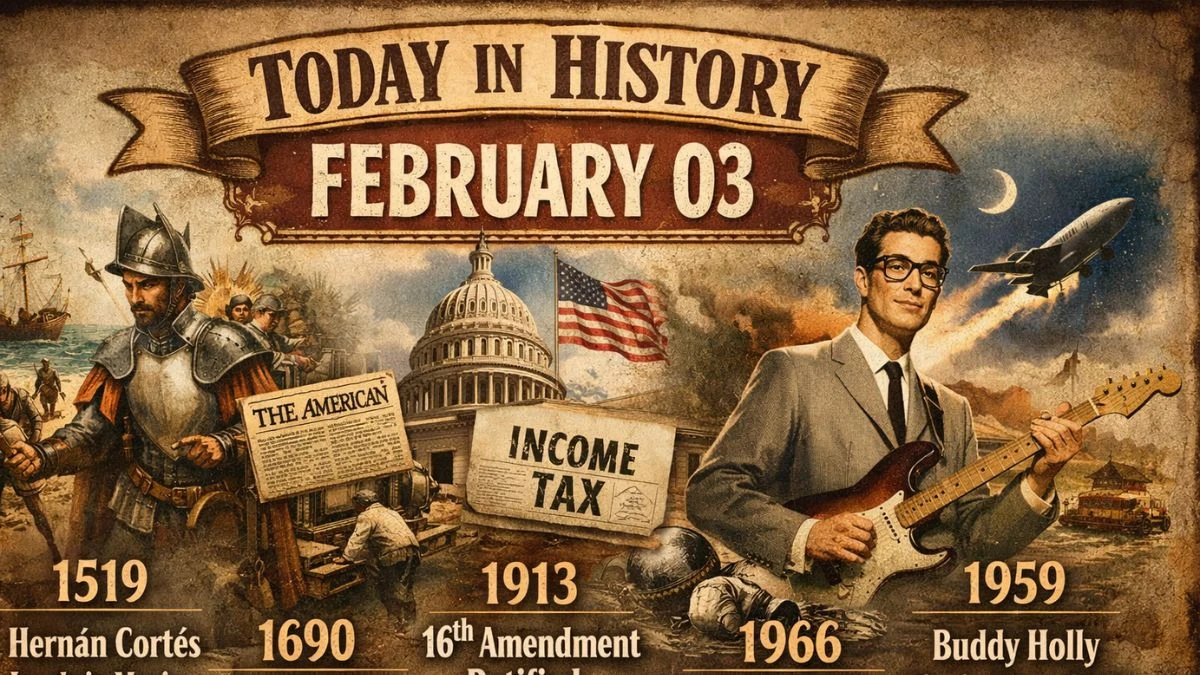

Today in History, February 3: What Happened on This Day?
What gives a single date its lasting weight in human memory? Across centuries, certain days quietly gather meaning as political decisions, scientific milestones, cultural moments, and personal achievements unfold upon them. February 3 is one such date—marked not by a single defining moment, but by a steady accumulation of events that shaped institutions, altered global understanding, and influenced everyday life.
From the foundations of modern finance to historic advances in space exploration, the date reflects how progress often emerges through measured, incremental change rather than dramatic turning points. In more recent decades, February 3 has continued to carry relevance through developments in science, technology, sports, and the arts that still influence contemporary society.
Earlier centuries saw this day connected to constitutional reform, the establishment of economic systems, and notable figures whose contributions crossed national boundaries. Taken together, these events illustrate how February 3 links past decisions with present realities. Understanding what happened on February 3 offers a broader perspective on how history unfolds—layer by layer—across generations.
February 3 – Major Historical Events
1792 – Founding of the New York Stock Exchange
- Merchants and brokers signed the Buttonwood Agreement in New York City.
- Agreement formalized securities trading practices and membership rules.
- Laid the foundation for organized financial markets in the United States.
- NYSE later became one of the world’s most influential stock exchanges.
1870 – Ratification of the 15th Amendment
- United States formally ratified voting rights protections nationwide.
- Prohibited denying suffrage based on race, color, or previous servitude.
- Marked a key milestone during the Reconstruction era after the Civil War.
- Enforcement challenges persisted despite constitutional guarantees in many states.
1913 – Ratification of the 16th Amendment
- Authorized the U.S. federal government to levy income taxes.
- Reduced reliance on tariffs and indirect taxation for public revenue.
- Provided long-term funding structure for federal programs and services.
- Fundamentally reshaped American fiscal policy in the twentieth century.
1945 – End of the Battle of Manila
- Allied forces liberated Manila from Japanese occupation during World War II.
- One of the most destructive urban battles of the war in the Pacific.
- Civilian casualties and infrastructure damage were extensive across the city.
- Marked a major turning point in the campaign to retake the Philippines.
February 3 – Technology News On This Day
1966 – Luna 9 Achieves First Soft Landing on the Moon
- Soviet spacecraft successfully landed on the lunar surface intact.
- Transmitted the first panoramic images taken from the Moon’s surface.
- Demonstrated feasibility of controlled landings for future lunar missions.
- Influenced subsequent space exploration planning by multiple countries.
1998 – Netscape Announces the Mozilla Open-Source Project
- Company made browser source code available to public developers.
- Encouraged collaborative software development and transparent review practices.
- Helped shape standards-based web technologies and modern browser competition.
- Mozilla later contributed to broader open-source software adoption globally.
February 3 – Music History On This Day
1959 – Buddy Holly’s Final Performance
- Buddy Holly performed his last concert in Clear Lake, Iowa.
- Show took place during the “Winter Dance Party” tour run.
- Occurred days before the fatal plane crash that followed the tour.
- Later became a key reference point in early rock and roll history.
1976 – Paul Simon’s Album Gains Major International Recognition
- Work achieved significant commercial success across multiple markets.
- Featured refined songwriting and arrangements influenced by jazz styles.
- Earned high-profile industry recognition, including major award wins.
- Helped broaden expectations of mainstream pop and singer-songwriter albums.
February 3 – Sports Events History
1968 – Super Bowl II and the Expansion of Sports Broadcasting
- Super Bowl II drew national attention as television audiences expanded.
- Green Bay Packers defeated the Oakland Raiders to win the championship.
- Broadcast technology improvements helped bring major games to wider audiences.
- Event strengthened the commercial model for modern sports media coverage.
2013 – Baltimore Ravens Win Super Bowl XLVII
- Ravens defeated the San Francisco 49ers in New Orleans.
- Game included a widely noted power outage that delayed play.
- Victory delivered the franchise’s second Super Bowl title.
- Highlighted the sport’s expanding international viewership and media reach.
February 3 – Births and Deaths
Notable Births
Felix Mendelssohn (1809–1847)
- German composer, pianist, and conductor of the Romantic era.
- Helped revive interest in Johann Sebastian Bach’s major works.
- Influenced orchestral and choral traditions across European music.
Norman Rockwell (1894–1978)
- American illustrator known for detailed narrative realism.
- Created iconic covers for The Saturday Evening Post.
- Chronicled everyday American life and civic themes for decades.
Morgan Fairchild (1950– )
- American actress and television personality with a long career.
- Known for prominent roles in prime-time television dramas.
- Maintained a sustained presence in popular culture and entertainment media.
Notable Deaths
Johannes Gutenberg (c.1400–1468)
- Credited with advancing movable-type printing in Europe.
- Printing technology accelerated literacy, learning, and information exchange.
- Enabled wider distribution of texts, shaping education and public discourse.
Buster Keaton (1895–1966)
- American silent film actor, director, and innovative visual storyteller.
- Known for physical comedy, precise timing, and inventive stunts.
- Influenced later generations of filmmakers and screen comedians worldwide.
John Paul Jones (1747–1792)
- Naval commander during the American Revolutionary War.
- Regarded as a foundational figure in the early U.S. Navy.
- Remembered for strategic leadership and notable wartime engagements.