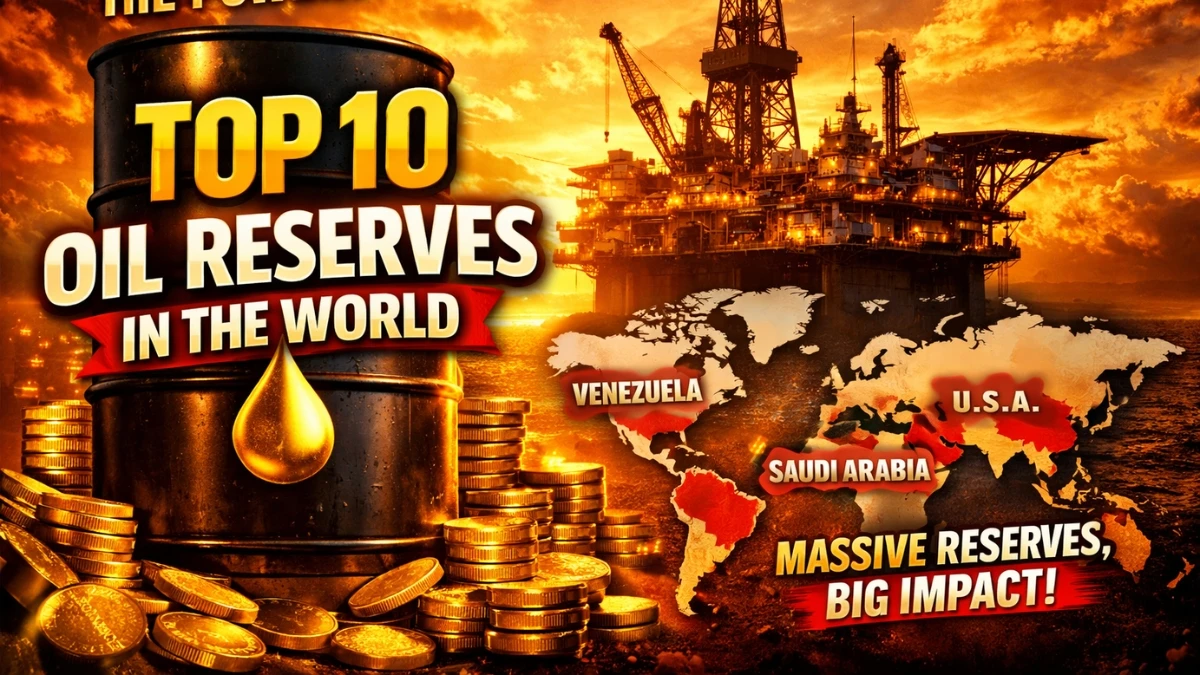

Top 10 countries with the largest oil reserves in the world might sound like a dry ranking, but in reality it’s a quiet power list that shapes everything from fuel prices at your neighbourhood pump to diplomatic handshakes at global summits.
Oil is still the backbone of the modern economy, and even in a world talking loudly about renewables, the countries sitting on massive proven reserves hold a kind of long-term leverage that is hard to ignore.
In 2024, global oil demand averaged around 103.84 million barrels per day, a record level, nudging up 1.5% from the previous year, which tells you the “post‑oil era” is not here yet, no matter how many electric cars show up in ads.
At the same time, the latest data on proven reserves shows that the world still has roughly 1.57 trillion barrels of crude in the ground, with only a tiny 0.1% increase year‑on‑year, so the pie is not expanding dramatically, but who controls the biggest slices really matters.
What makes this list interesting is not just who is on it, but how different their stories are: some are petro‑states whose budgets rise and fall with oil prices, others are diversified economies where oil is just one powerful card in a larger deck.
Let’s walk through the top 10, but in a way that feels a bit more human than just a table of numbers.
Top 10 Countries With Largest Oil Reserves in The World
The world’s largest oil reserves are heavily concentrated in a handful of countries, led by Venezuela, Saudi Arabia, Canada and key Middle Eastern producers like Iran and Iraq.
These ten nations together hold the majority of proven crude oil reserves, and that reality underpins global energy security debates, OPEC decisions, and even regional conflicts.
Venezuela remains number one with over 303 billion barrels, nearly one‑fifth of the global total, while Saudi Arabia, Iran, Iraq, Canada, Kuwait, UAE, Russia, Libya, and the United States round out the top tier with tens of billions of barrels each.
| S.No | Country | Oil Reserves (in million barrels) |
|---|---|---|
| 1 | Venezuela | ~303,221 mb |
| 2 | Saudi Arabia | ~267,200 mb |
| 3 | Iran | ~208,600 mb |
| 4 | Canada | ~163,440 mb |
| 5 | Iraq | ~145,019 mb |
| 6 | United Arab Emirates | ~113,000 mb |
| 7 | Kuwait | ~101,500 mb |
| 8 | Russia | ~80,000 mb |
| 9 | Libya | ~48,363 mb |
| 10 | United States | ~45,014 mb |
Numbers are important, but they don’t tell you how it actually feels inside these countries when oil prices swing, or how a new discovery (or sanctions, or a war) can turn a technical statistic into a national crisis or windfall.
In some places, people joke that they live “on a lake of oil but drink imported water”, a dark but honest way of capturing the strange imbalance between underground wealth and everyday life.
Venezuela: Sitting on a Giant, Stuck in a Squeeze
Venezuela has the largest proven oil reserves in the world, at just over 303 billion barrels, yet its people have lived through fuel shortages and economic collapse, a paradox that would be hilarious if it weren’t so tragic.
Most of its crude is heavy and extra‑heavy, which is harder and more expensive to process, and years of underinvestment, mismanagement, and sanctions have turned what should be a golden ticket into a daily struggle for basic stability.
Ask anyone who visited Caracas in the last decade and they might tell you a story like this: standing in a long line for petrol in a country that, on paper, has more oil than anywhere else on Earth.
That lived contradiction is crucial context when looking at “largest reserves”, huge numbers do not automatically translate into widespread prosperity or political calm.
Saudi Arabia and the Middle East Core
Saudi Arabia ranks second globally with around 267 billion barrels of proven reserves and long‑standing status as OPEC’s central power broker.
When Riyadh speaks about production cuts or increases, traders listen, and governments quietly recalculate budget forecasts.
Oil revenue has funded large‑scale infrastructure, social programmes, and now big diversification bets under “Vision” strategies aimed at preparing for a less oil‑dependent future.
The region as a whole is a powerhouse:
- Iran holds more than 200 billion barrels, despite facing sanctions and political headwinds that complicate its ability to fully monetise those reserves.
- Iraq, with roughly 145 billion barrels, continues to rebuild and attract investment even after years of conflict, with oil exports playing a central role in its fiscal survival.
- The UAE, Kuwait and Qatar (though not all in the top‑10 list by reserves) collectively anchor the Gulf’s reputation as the world’s oil “bank,” mixing sovereign wealth funds, airlines, tourism and tech investment with their hydrocarbon base.
A friend who worked on a rig in the Gulf once joked that his commute went “from the mall to the desert to the middle of the sea,” which is surprisingly accurate: hyper‑modern cities funded by oil cheques sitting right next to the harsh environments where that oil is actually extracted.
Canada, Russia and the United States: Non‑OPEC Heavyweights
Canada holds the fourth‑largest proven oil reserves, largely thanks to its oil sands, with around 163 billion barrels officially on the books.
Those reserves are more carbon‑intensive to develop, which means any discussion about Canadian oil quickly runs into climate policy, Indigenous rights, and pipeline politics as much as geology.
If you’ve ever seen a town split over a new pipeline project, jobs versus environmental risk, you’ve felt how “proven reserves” turn into very un‑abstract arguments at community halls.
Russia and the United States also sit comfortably in the top tier, with roughly 80 billion and 45 billion barrels respectively.
Russia’s reserves are deeply entangled with geopolitics and sanctions; energy exports have long been a strategic lever in its foreign policy, especially toward Europe.
The US is interesting because it’s both a major producer and consumer, and a lot of its recent story is about shale, technology and finance unlocking resources once considered uneconomic.
That shale boom reshaped global trade flows, and you can still feel its impact in how Washington talks about “energy independence” and in how OPEC responds to US output.
Disclaimer: The information provided is based on the latest available data about global oil reserves and the geopolitical, economic, and environmental factors influencing oil production and consumption. Oil reserves figures are estimates and can change over time due to new discoveries, technological advancements, or shifts in geopolitical situations. The content is meant for educational and informational purposes.