
UGC Bill 2026
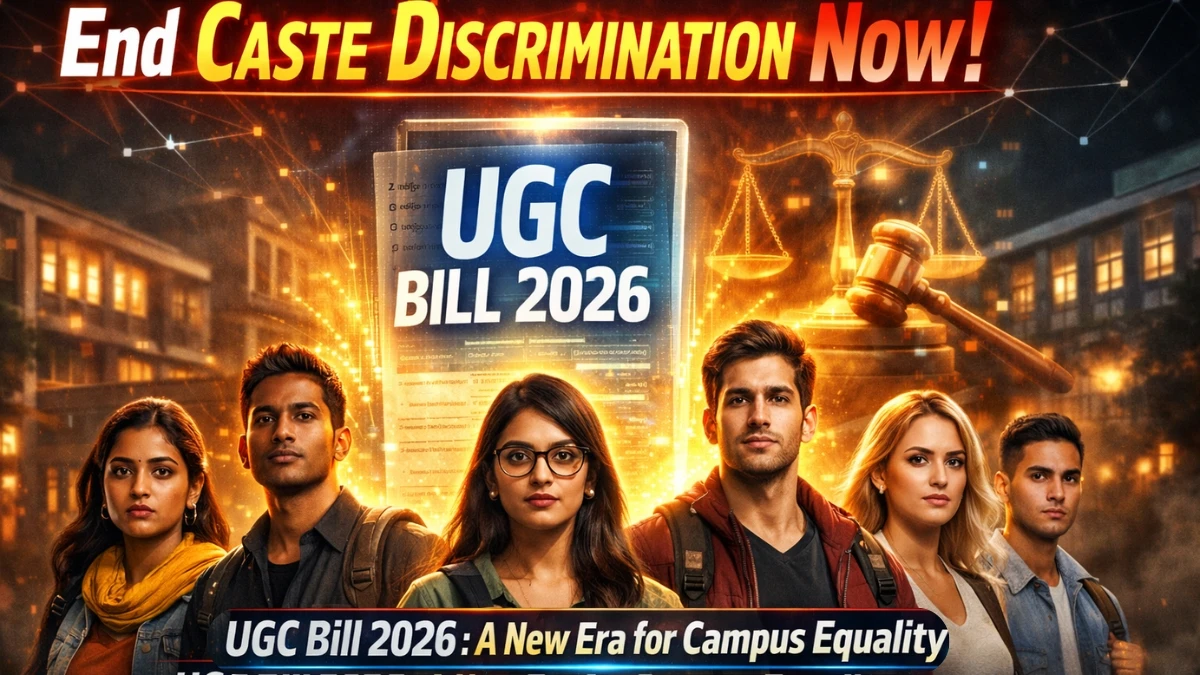
The UGC Bill 2026 is a new set of mandatory equity regulations for higher education that aims to tackle caste-based discrimination on campuses head‑on, instead of just politely advising colleges to “do better.”
It’s officially called the UGC Promotion of Equity in Higher Education Institutions Regulations, 2026, notified on 13 January 2026, and it replaces the much softer 2012 anti‑discrimination guidelines.
In simple terms, this is UGC telling every university and college in India: “You can’t treat discrimination as someone else’s problem anymore. It’s yours. Own it, fix it, and show us proof.”
At its core, the Bill tries to respond to something most students already know, even if they never put it into words: caste doesn’t magically vanish at the college gate.
Students from SC, ST, OBC and other marginalised backgrounds have routinely reported humiliation, exclusion, biased grading, and harassment, all of which can quietly destroy confidence and academic performance.
The 2026 regulations try to move from symbolic statements to enforceable systems: clear definitions of discrimination, structures inside each institution, strict timelines for action, and digital monitoring from the UGC’s side. It’s ambitious, messy, controversial, and honestly, long overdue.
What is UGC Trying to Do With This Bill?
The UGC’s basic goal with the 2026 Bill is to make campuses safer, fairer, and more accountable, especially for students who’ve historically been pushed to the margins. This is why the rules focus on:
- Defining what discrimination actually means in policy language
- Making it mandatory for institutions to have equity bodies and complaint systems
- Putting time limits on how quickly complaints must be handled
- Allowing UGC to monitor, nudge, and if needed, penalise institutions that don’t take cases seriously
Unlike the 2012 regulations, which were largely advisory and easy to ignore, the 2026 framework is enforceable. UGC can now track cases via a central portal, ask why things are delayed, and potentially affect funding or recognition if institutions refuse to follow the rules.
For students, this doesn’t mean every problem will be magically solved, but it does mean colleges can’t just bury complaints in a file and hope the semester ends before anyone asks questions.
The Heart of the Controversy: Regulation 3(c)
One reason you’re hearing so much about the UGC Bill 2026 is Regulation 3(c), which defines caste‑based discrimination in a way that specifically mentions SC, ST, and OBC communities as protected groups.
A Public Interest Litigation (PIL) filed by advocate Vineet Jindal (Vineet Jindal vs Union of India) argues that this definition is unconstitutional because it ignores the possibility that “general category” students can also face caste‑based hostility, abuse, or exclusion.
The Supreme Court, led by Chief Justice Surya Kant, has agreed to urgently hear this challenge and has noted that it is aware of the concerns around how the regulation defines caste discrimination. Critics say:
- By naming only SC, ST, and OBC as possible victims, the rule creates an unfair classification and could violate Article 14 (equality before law).
- It risks creating a perception that some groups are “victims by default” and others are “perpetrators by default,” which feels like a return to a colonial mindset of group‑based guilt.
Supporters of strong protections for marginalised students counter that the rule reflects ground reality: data repeatedly show disproportionate violence, harassment, and exclusion against historically oppressed castes, and policies often need to be targeted to address structural inequality.
The tension here isn’t simple; it’s a genuine clash between substantive equality (protecting those most harmed) and formal equality (everyone treated the same on paper).
Personally, I think this is where the real debate should be happening: not “should there be protections?” (obviously yes) but “how do we write them in a way that stays sharp enough to help those who need it most, without turning policy into a new source of resentment or unfairness?” There’s no one‑line answer, and the fact that the Supreme Court has stepped in shows how serious the questions are.
What Changes on Campus: EOCs, Equity Committees, and Deadlines
On the ground, the UGC 2026 rules mean every higher education institution has to build new equity structures, not just ad‑hoc committees that meet when something explodes.
Some of the key requirements:
Equal Opportunity Centres (EOCs) – Mandatory
- Every university and college must set up an EOC. This isn’t just a token office; it’s supposed to be the nerve centre for inclusion, handling:
- Support for disadvantaged students (academic, financial guidance)
- Awareness programmes for faculty and students
- Campus‑level inclusion initiatives
Equity Committee (and optional Equity Squads)
- Each EOC must have an Equity Committee headed by the Vice‑Chancellor or Principal, with representation from:
- SC, ST, OBC members
- Women
- Persons with Disabilities (PwBD)
Institutions are also encouraged to form Equity Squads — small teams that proactively visit hostels, labs, canteens, messes and other “informal” spaces to check on bullying, harassment or exclusion.
Strict complaint timelines
- The regulations include clear, almost “SLA‑style” timelines:
- Within 24 hours: initial action after a complaint is filed
- Within 15 working days: investigation report to be completed
- Within 30 days: student can appeal to an Ombudsperson if unsatisfied
On paper, this looks very procedural, almost corporate. But imagine being a student who’s been stuck for months waiting for the administration to acknowledge a serious complaint; having a 24‑hour window and a 15‑day report requirement suddenly looks like a lifeline.
Of course, the real test will be whether colleges actually follow these timelines, or just go through the motions.
UGC 2012 vs UGC 2026: What’s Really Different?
If you’re wondering, “Didn’t UGC already have anti‑discrimination rules?”, you’re right. But the 2012 regulations were comparatively weak, and enforcement was patchy. The 2026 framework is a direct attempt to fix that.
In broad strokes:
- 2012: advisory, soft, focused mainly on discrimination, often ignored.
- 2026: mandatory, broader scope (caste, religion, gender, disability, region, race), with stronger monitoring and explicit penalties for non‑compliance.
The new rules also introduce MANAS‑SETU, a national monitoring portal where all institutions must link their internal grievance systems. This allows:
- Real‑time tracking of complaint status by UGC
- Automatic reminders to upload FIR details within 24 hours if a case involves a potential criminal offence
For students, this means complaints are no longer trapped inside campus walls; there’s at least a channel through which higher authorities can see what’s going on.
I’ve heard so many stories of students saying, “We complained, but nothing moved.” The portal doesn’t magically guarantee justice, but it does make silence harder to hide.
Why the UGC Bill 2026 Matters (Beyond the Legal Arguments)
The UGC Bill 2026 matters because it acknowledges something uncomfortable: universities and colleges aren’t automatically progressive just because they teach sociology and constitutional law.
Discrimination, especially caste‑based, has been quietly shaping who feels welcome in classrooms, who gets opportunities, and who silently drops out.
This regulation:
- Forces institutions to build visible structures for equity, not just posters on walls.
- Gives students clearer pathways to complain and escalate when things go wrong.
- Opens up a necessary debate about how we define and address caste discrimination in a way that is both protective and fair.
It’s not a perfect law. It’s already controversial, and the Supreme Court’s decision on Regulation 3(c) will probably shape how it’s implemented in the long run.
But if you care about campuses where students aren’t humiliated or sidelined because of their caste, this is a conversation worth watching closely, and, where possible, participating in, whether you’re a student, teacher, parent, or just someone who remembers exactly how it felt to be on the wrong side of “casual” discrimination in college.
Disclaimer:
The views and information shared in this article regarding the UGC Bill 2026 are based on current interpretations and perspectives. This content is intended for informational purposes only and does not constitute legal advice. The UGC Bill 2026 and its impact may evolve over time, and individuals should refer to official government notifications or consult legal professionals for specific guidance.