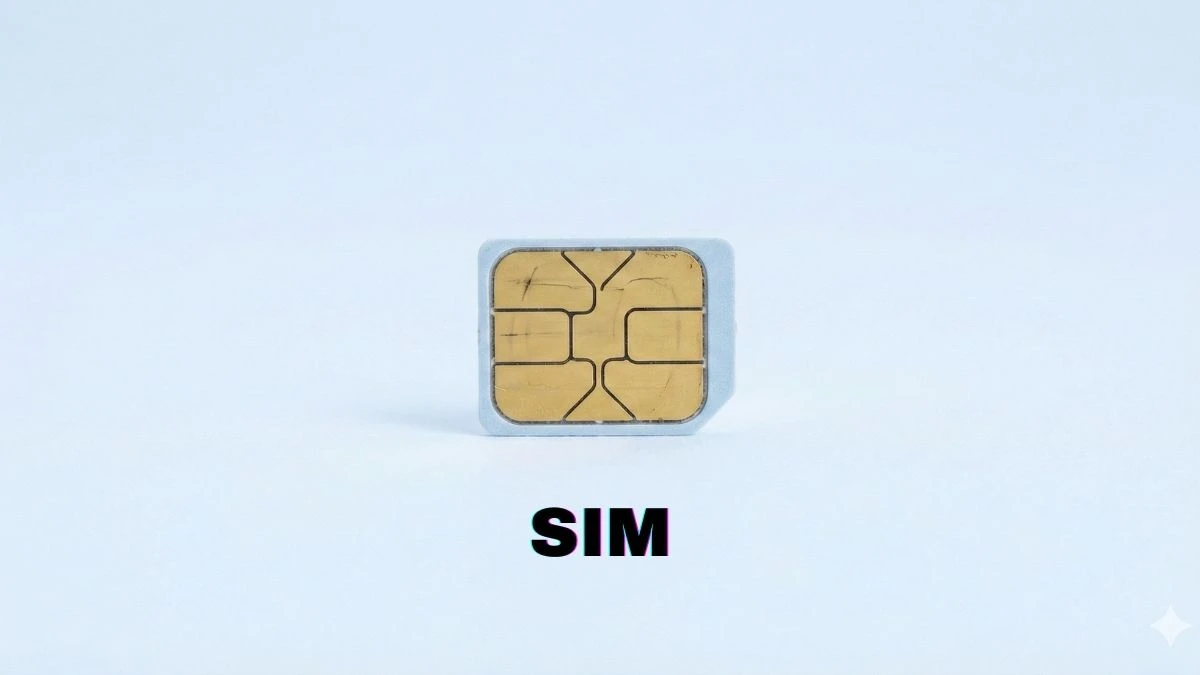

Quotes and technical terms show up everywhere in tech, but “SIM” is one of those words people use daily without ever thinking about what it actually stands for. The small plastic card (or now just a tiny chip or even a built‑in “eSIM”) quietly decides whether a phone can call, text, or use mobile data, yet for many users it’s just “that thing the shop guy cuts and inserts.”
Understanding the full form of SIM, how a SIM card works, and where it came from makes mobile technology feel much less like magic and more like a smart, well-organised ID system.
What is the Full Form of SIM?
The full form of SIM is Subscriber Identity Module (also known as Subscriber Identification Module in some references). In simple terms, a SIM is a tiny smart card or embedded chip that stores key identity and security information so that a mobile network can recognise a subscriber and allow services like calls, SMS, and data.
A SIM card typically stores:
-
IMSI (International Mobile Subscriber Identity) – the unique number that identifies the subscriber on the network.
-
ICCID (Integrated Circuit Card Identifier) – the serial number of the SIM card itself.
-
Authentication key (Ki) and security data – used to prove that the subscriber is genuine and to encrypt communication.
-
Network details like service centre numbers, some contacts, and SMS settings (depending on operator and phone).
Without a valid Subscriber Identity Module, a device is basically just a camera, music player, and offline gadget; the SIM is what unlocks the actual “mobile connection” identity.
How Does a Sim Card Work?
A SIM card works by securely identifying a subscriber to the mobile network using a challenge–response authentication process and then helping encrypt the communication. When a phone is switched on with a SIM inside, it reads the IMSI from the SIM and sends it to the operator’s network to ask for access.
Very simply, the flow looks like this:
-
The network checks the IMSI in its database and finds the matching secret authentication key (Ki) stored on its side.
-
The network sends a random “challenge” to the SIM.
-
The SIM uses the hidden Ki and a built‑in algorithm to generate a response and sends this back.
-
If the network’s own calculation and the SIM’s response match, the subscriber is authenticated and access is granted.
-
After that, a session key is used to encrypt voice and data traffic, keeping communication more secure.
This is why even a cheap feature phone with a valid SIM can securely connect, while an expensive smartphone without a SIM (or with an invalid one) cannot join the mobile network in the normal way.
History of SIM Cards
The modern SIM card has its roots in the early 1990s, alongside the rise of GSM mobile networks. The first commercial SIM cards were manufactured in 1991 by the German smart‑card firm Giesecke+Devrient, which supplied the initial batch to the Finnish operator Radiolinja when it launched one of the first 2G GSM networks.
From there, the evolution went something like this:
-
Early SIMs were credit‑card sized and used in bulky phones, more like “mobile bricks” than smartphones.
-
As GSM spread across Europe and then globally in the 1990s, SIM sizes shrank to mini, micro, and eventually nano form factors to fit sleeker devices.
-
Later came eSIM (embedded SIM) and iSIM, where the “Subscriber Identity Module” functions are built directly into the device hardware, with profiles downloaded digitally instead of using physical cards.
Over roughly three decades, the SIM card moved from being a visible plastic card users physically swapped, to becoming an almost invisible security layer inside phones, tablets, and even IoT devices like smart meters and connected cars.
Yet the core idea stayed the same: a secure module that proves “who the subscriber is” to the network every time the device connects.