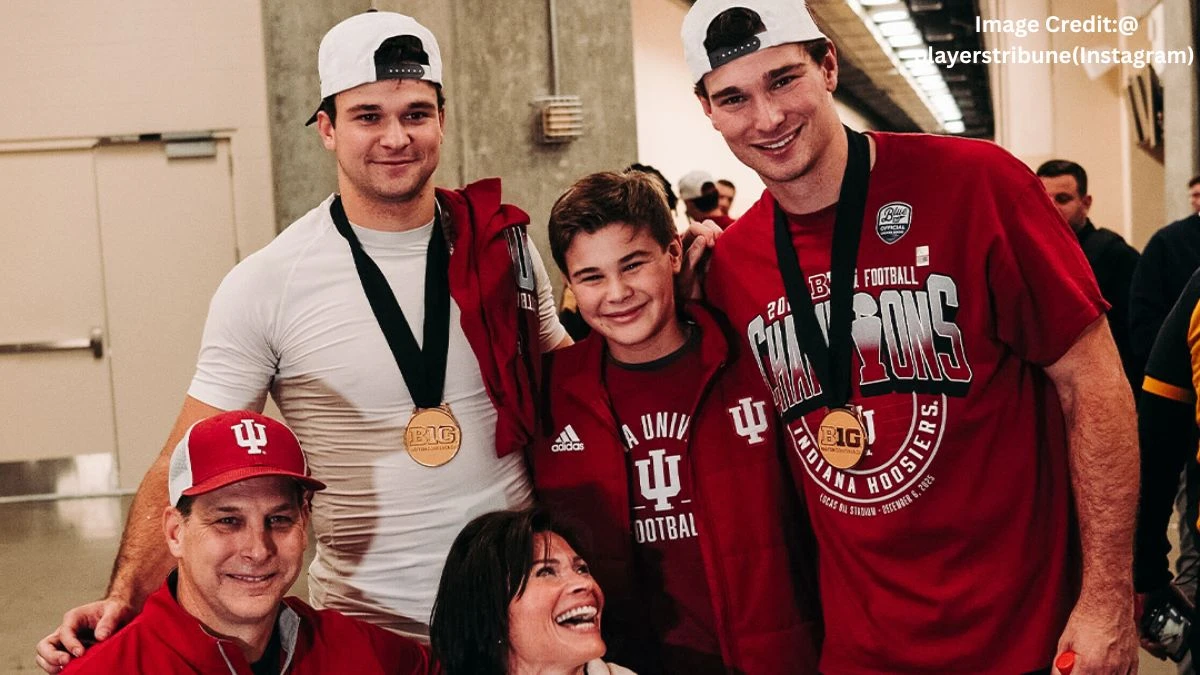

Who is Elsa Mendoza?
Elsa Mendoza is a former University of Miami tennis player, a mom of three, and the long‑time MS warrior who raised Heisman winner Fernando Mendoza in a tight‑knit Cuban‑American family.
She grew up in Miami, later moved to Boston in her 20s, and was pregnant with Fernando at 25, long before anyone imagined her kid would be standing in New York holding college football’s biggest individual award.
People who’ve met her describe her as competitive but gentle: the type of mom who would push you to finish your homework, then yell herself hoarse in the bleachers the next day.
She’s also deeply educated holding multiple degrees from the University of Miami and for years was the one driving to practices, managing school schedules, and quietly hiding her diagnosis so her kids could just be kids a little longer.
What Happened to Fernando Mendoza’s Mom?
Fernando Mendoza’s mom, Elsa, was diagnosed with multiple sclerosis about 18 years ago and has been living with the disease ever since, now often using a wheelchair on game days. In her own words, she initially hid the diagnosis from her sons, wanting them to focus on childhood and football instead of worrying about medical terms they couldn’t yet understand
Over time, MS has changed how she moves but not how she shows up: she traveled to big games, watched Fernando win championships from a wheelchair at Lucas Oil Stadium, and became a visible symbol of resilience for Indiana fans.
Fernando and his brother Alberto have used his platform to raise money and awareness for MS, turning family pain into a cause charity events, mentions in interviews, and constant reminders that this trophy run is also about fighting a disease that tried to slow their mother down.
Fernando Mendoza’s Mother Writes a Letter in the Players’ Tribune
Yes, that viral letter titled “Dear Fernando” in The Players’ Tribune was written by his mom, Elsa, as he headed into the Heisman Trophy ceremony. It’s not a PR‑polished open letter; it reads more like the kind of long, slightly rambly message a parent sends when they know their kid is standing at the edge of a huge moment and they want to say… basically everything.
In it, she walks through small memories of baby Fernando, who felt more like her “buddy,” the kid learning to throw tennis balls, the teenager switching high schools, the college player wrestling with a transfer decision.
She even jokes about him exaggerating how much she “taught him to throw,” gently correcting the record while still letting him be sweet.
The line that stuck with a lot of people is her insistence that his accomplishments “will NEVER impact how proud” she is of him, classic mom energy, but it hits different when it’s aimed at a Heisman finalist with the entire country watching.
Fernando Mendoza Thanks His Mother During Heisman Trophy Ceremony
During the Heisman Trophy ceremony in December 2025, Fernando Mendoza used his biggest stage to dedicate the award to his mom, telling Elsa that the trophy was “as much hers as his” and calling her his “biggest supporter” and “why.” @MLFootball shared on X that Indiana quarterback Fernando Mendoza, after winning the Heisman Trophy, told his mother, Elsa Mendoza, who has Multiple Sclerosis, “Together you and I are rewriting what people think is possible.”
It wasn’t a polished brand speech; his voice shook, he fought tears, and you could see him glance toward her in the crowd like a kid looking for approval after a school play except this time, the whole country was watching.
He talked about her sacrifices, her courage, and how her quiet strength became his first “playbook,” the one that taught him grit before any coach drew up a play.
He even slipped into Spanish to thank his grandparents, tying his mom’s struggle with MS to the wider story of a Cuban‑American family that pushed through immigration, illness, and doubt to get to that stage in New York.
Who is Fernando Mendoza?
Fernando Mendoza is a 6‑foot‑3 quarterback from Miami who led Indiana to a breakout season and won the Heisman Trophy in 2025, becoming one of college football’s biggest stories.
He grew up as the eldest of three boys in a sports‑obsessed, Cuban‑rooted household where weekend plans were basically: church, family, and someone throwing a ball in the backyard until it got dark.
He played high school football at Christopher Columbus High School in Miami, then eventually emerged at Indiana as the kind of quarterback who mixes accuracy with a calm, almost old‑soul poise under pressure.
When he talks publicly, he rarely centers himself; it’s always “we” his linemen, his brother, his parents, his grandparents which is probably why that Heisman speech landed so hard with people who’ve never watched a single Indiana snap.
Fernando Mendoza’s Parents
Fernando’s parents are Elsa Mendoza and Fernando Mendoza Sr., a pair of former college athletes who passed down both genetics and an almost stubborn work ethic. Elsa played tennis for the University of Miami, while Fernando Sr. rowed at Brown University, so family dinner conversations were less “should you play sports?” and more “which one are you playing, and how serious are you about it?”
They raised three sons Fernando, Alberto, and Max mostly in Miami, showing up together at games, from youth leagues all the way to Big Ten stadiums.
Both parents are frequently seen in the stands at Indiana, and Fernando credits them with teaching him discipline, faith, and how to handle being overlooked, especially during the recruiting phase when big offers were slow to come, and Elsa had to talk him through those “crying on the bed” nights.
Fernando Mendoza Age
Fernando Mendoza is 22 years old, born on October 1, 2003, in Miami, Florida. That puts him right in that funny space where he’s old enough to be a national sports figure, yet still young enough that his mom’s letter in The Players’ Tribune can make him tear up like a teenager getting dropped off at college.
At 22, he has already won a Heisman Trophy, led Indiana on a historic run, and turned his family story, immigrant grandparents, a mom with MS, parents who were college athletes, into something a lot of fans quietly see themselves in.
And if his own words are any indication, he still treats all of it as an extension of Elsa’s belief that strength can be soft‑spoken and that sometimes the most important yards gained aren’t on a football field at all.
Disclaimer
This article is for general informational and educational purposes only and should not be taken as medical, legal, or professional advice. Details about public figures are based on publicly available sources and may evolve over time. Readers should verify key facts independently before relying on them.