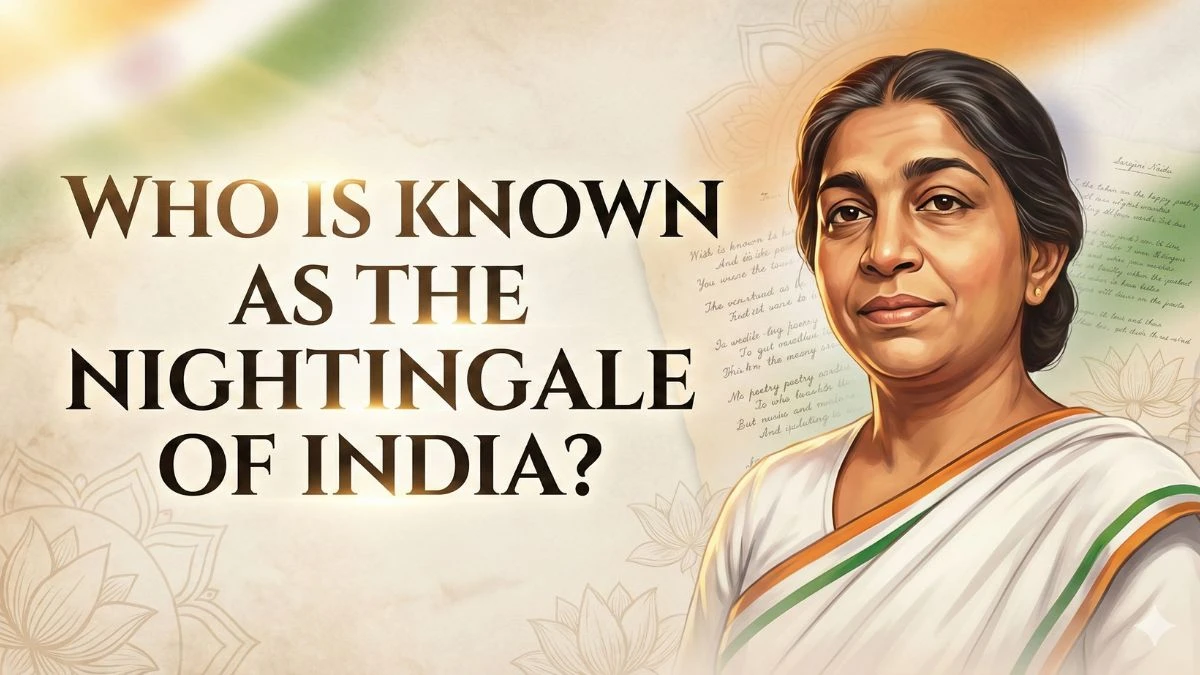

Who is Known as the Nightingale of India?
The Nightingale of India is Sarojini Naidu, a poet, freedom fighter, and one of the most influential women leaders of India’s independence movement.
The nickname “Bharat Kokila” or “Nightingale of India” stuck to her so strongly that many students first hear the title before they even learn her full biography.
In school books, competitive exams, and even current affairs capsules, this question keeps coming up because it links literature, history, and the freedom struggle in one line.
Her image today is a blend of two roles that rarely come together this well: a lyrical English-language poet and a sharp political strategist who could hold her own alongside leaders like Mahatma Gandhi and Jawaharlal Nehru.
That combination is exactly why her name still feels relevant in conversations about women’s leadership, nationalism, and Indian English poetry.
Why Did Sarojini Naidu Earn the Name Nightingale of India?
Sarojini Naidu earned the title Nightingale of India because her poetry was famously musical, emotionally rich, and often compared to the melodious song of a nightingale.
Her verses carried rhythm, imagery, and patriotism in a way that sounded almost like songs rather than just printed lines on a page.
The title itself is widely attributed to Mahatma Gandhi, who admired how her lyrical poetry and oratory could move people during the freedom movement.
Just as a nightingale’s voice can transform a quiet evening, her speeches and poems were said to energize crowds, particularly at Congress sessions and public meetings. In a political space often dominated by heavy, legalistic language, her poetic style brought warmth and accessibility, something people remembered long after the meetings ended.
Who was Sarojini Naidu?
Sarojini Naidu was an Indian poet, political activist, and one of the first women to rise to the top national leadership positions in modern India.
Born on 13 February 1879 in Hyderabad to scientist-philosopher Aghornath Chattopadhyaya and poet Barada Sundari Devi, she grew up in an intellectually charged, culturally rich household that encouraged learning and debate.
She studied in England at King’s College, London, and Girton College, Cambridge, where she refined her English literary style even as her mind turned increasingly towards Indian nationalism.
Over time, her life moved from being primarily that of a celebrated poet to a frontline freedom fighter who travelled widely, addressed massive gatherings, and represented India in international forums.
Many contemporaries remembered her not just for her ideas, but for the warmth and humor she carried into intense political discussions.
Sarojini Naidu: Key Achievements
Sarojini Naidu’s achievements cut across literature, politics, and social reform, making her legacy much larger than a single title like “Nightingale of India.” A quick snapshot helps show why her name appears repeatedly in history and polity discussions even today.
Some of her major milestones often highlighted in exams and reference material are:
-
First Indian woman to become President of the Indian National Congress (1925, Kanpur session), a landmark moment in national politics.
-
First woman to serve as governor of an Indian state (Governor of the United Provinces, now Uttar Pradesh, after Independence).
-
Acclaimed poet with notable collections like The Golden Threshold (1905), The Bird of Time (1912), and later collected works such as The Sceptred Flute.
-
Active participation in major movements including the Non-Cooperation Movement, Civil Disobedience, the Salt March alongside Gandhi, and later the Quit India Movement, for which she also faced imprisonment.
-
Strong voice for women’s rights and education, using both her poetry and speeches to argue for women’s participation in public life and national decision-making.
Taken together, these achievements explain why Sarojini Naidu is remembered not only as the Nightingale of India, but as a key architect of India’s political and cultural identity in the early 20th century.
Her story continues to serve as reference material for students, researchers, and readers looking for real historical examples of courage, creativity, and leadership in one person.
Disclaimer
Information about Sarojini Naidu, her title “Nightingale of India,” and related historical details is based on widely accepted historical and literary sources. Readers should cross-check dates, events, and interpretations with official textbooks or academic references, especially for exams, research, or formal academic use.