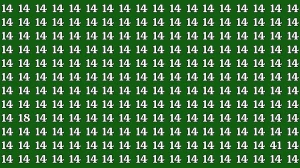
Pattern recognition becomes exponentially harder when numbers share similar curves and spacing. This visual challenge presents a grid packed with the number 87 repeated hundreds of times but hidden somewhere is a single 18.
The digit similarity makes this deceptively difficult, with most viewers scanning multiple times before spotting the outlier. Can you find it in under 9 seconds?
The Challenge
At first glance, every number appears identical.
Your mission: Locate the single 18 hidden among all the 87s in the grid above. Set your timer for 9 seconds and begin scanning!

Why This Illusion Tricks Your Eyes
The human visual system excels at pattern recognition through rapid categorization—your brain groups similar shapes together to process information efficiently. When confronted with repetitive elements like this grid of 87s, your visual cortex shifts into scanning mode, looking for obvious deviations.
Here's what makes this puzzle particularly challenging: the numbers 18 and 87 share remarkably similar visual characteristics. Both contain curved digits, and the spacing between characters creates comparable shapes. The digits 1, 7, and 8 all feature vertical or curved elements that blend together when repeated at this density.
Your brain expects uniformity in such patterns, so it naturally overlooks subtle variations. The more you stare at repeating 87s, the more your visual processing "locks in" to that pattern, making the different number functionally invisible even when you're looking directly at it.
This type of visual puzzle exercises your attention to detail and breaks you out of automatic pattern recognition—skills that improve with regular practice.
Still Searching? Here's Where to Look
Hint: Focus your attention on the lower right quadrant of the grid. The 18 appears in the bottom rows where visual fatigue is highest—precisely where most people stop scrutinizing individual numbers carefully.
The Solution
The hidden 18 is located in the bottom right corner of the grid.
Found it? The number 18 sits in the second-to-last row on the far right side of the grid. While 87 dominates the entire pattern, this single 18 breaks the uniformity. The key difference lies in the leading digit: the vertical line of "1" versus the curved "8" in 87, and the "8" versus "7" in the second position.
Despite these differences, the overall shape of "18" mimics the visual footprint of "87" closely enough that your brain categorizes it as part of the dominant pattern during rapid scanning.

The Cognitive Science Behind the Difficulty
Several psychological factors make this puzzle harder than it appears:
- Pattern saturation overload: When your visual field becomes saturated with a single repeating element, your brain assumes consistency and stops examining individual items. This cognitive shortcut saves mental energy but creates blind spots for anomalies like our hidden 18.
- Shape similarity interference: The numbers 1, 7, and 8 all share curved or linear features. Your brain processes the overall "shape" of two-digit numbers rather than analyzing each digit separately. Since "18" and "87" occupy similar visual space with comparable contours, they register as the same pattern to your rapid scanning system.
- Position-based attention decay: Research in visual perception shows that attention degrades as viewers scan downward and rightward across grids. The bottom right quadrant receives the least scrutiny—making it the optimal hiding spot for visual anomalies.
If you enjoy testing your observation skills, puzzles that exploit digit similarity provide excellent training for detail-oriented work. The challenge lies not in complexity but in overcoming your brain's efficiency mechanisms that prioritize speed over accuracy.
How Did You Perform?
- Under 9 seconds: Exceptional visual acuity—you likely have strong detail-orientation skills.
- 9-15 seconds: Above average—your scanning pattern is systematic and thorough.
- 15-25 seconds: Normal range—most people need multiple passes to locate the 18.
Over 25 seconds: The illusion worked as intended—pattern saturation overwhelmed your detection.
The key to improving: train your eyes to scan in deliberate patterns (left-to-right, top-to-bottom) rather than letting them jump randomly across the grid.
Pro Tip for Future Visual Puzzles
When faced with dense repetitive patterns, try the "quadrant method": divide the image into four sections mentally, then scan each quadrant separately. This prevents your brain from generalizing the entire image as a single pattern and forces more careful examination of each area.
This challenge typically requires 15-20 seconds for first-time solvers.