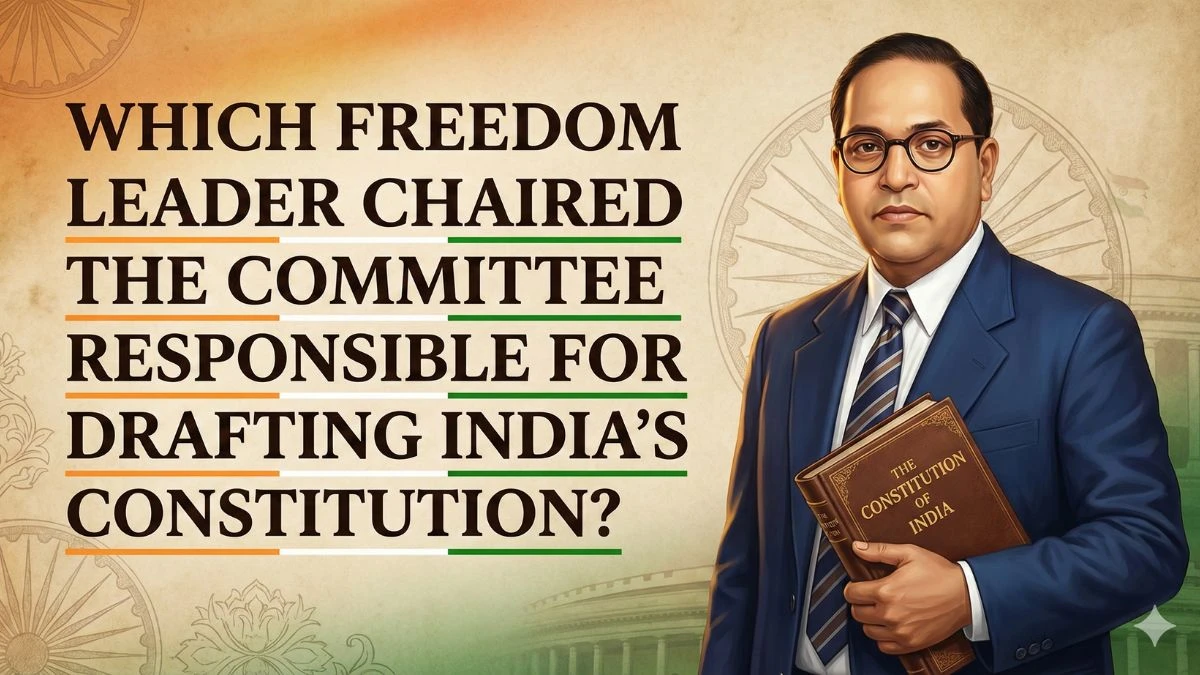

Which Freedom Leader Chaired the Drafting Committee of India’s Constitution?
The freedom leader who chaired the Drafting Committee responsible for drafting India’s Constitution was Dr. B. R. Ambedkar, often called the principal architect of the Indian Constitution.
A jurist, economist, and social reformer, Ambedkar brought a rare mix of legal expertise and lived experience of social discrimination into the Constituent Assembly debates.
Many members later recalled that in long, tiring sessions, his calm, precise replies to hundreds of amendments often decided the fate of key provisions on fundamental rights, federalism, and social justice.
There is also a reason exam questions love this topic: it sits at the intersection of modern history, polity, and social reform, so knowing that Ambedkar chaired the Drafting Committee becomes a kind of “anchor fact” for multiple subjects.
In public memory, images of him presenting the draft Constitution on 4 November 1948 and speaking on 25 November 1949 during the final adoption phase have become symbolic moments in India’s democratic story.
Drafting Committee Members
The Drafting Committee of the Indian Constitution originally had seven members, with Dr. B. R. Ambedkar as chairman and six other prominent leaders and legal minds alongside him. Over time, a couple of members were replaced due to resignation and death, but the core responsibility remained with this small, highly focused group.
A simplified snapshot of the main members often cited in polity notes looks like this (names may vary slightly across sources as replacements are included):
-
Dr. B. R. Ambedkar – Chairman, legal scholar, social reformer
-
Alladi Krishnaswami Ayyar – eminent barrister and constitutional expert
-
N. Gopalaswami Ayyangar – former Prime Minister of Jammu & Kashmir, later Union minister
-
K. M. Munshi – lawyer, writer, and later founder of Bharatiya Vidya Bhavan
-
Mohammad Saadulla – prominent political leader and lawyer
-
B. L. Mitter – Advocate-General of Bengal (later replaced due to ill health)
-
D. P. Khaitan – leading lawyer and industrialist (later passed away during the process)
In some detailed lists, N. Madhava Rau and T. T. Krishnamachari appear as replacements for members who stepped down or died, which is why students sometimes see more than seven names across different sources and get momentarily confused before exams.
What Was the Role of the Drafting Committee?
The role of the Drafting Committee was to take the broad decisions of the Constituent Assembly and its various committees and convert them into a coherent, legally sound draft Constitution for India.
It was not just “writing” the text; it was scrutinizing, rephrasing, harmonizing, and defending every clause so that the final document could actually work in practice as the supreme law of the land.
In practical terms, the committee:
-
Examined reports from committees on subjects like Union powers, provincial structures, and fundamental rights.
-
Integrated these reports into a single, logically organised draft of the Constitution.
-
Ensured internal consistency so that one article would not clash with another, especially on sensitive issues like emergency powers, reservations, and judicial review.
-
Revised the draft repeatedly in response to extensive debates and amendments proposed inside the Constituent Assembly.
The work was intense and slow: long days of clause-by-clause discussion, redrafting, and sometimes completely rethinking a provision when members raised serious concerns.
That is why Ambedkar and the committee are still credited not only with technical drafting, but with helping steer the political negotiations embedded inside the text.
When Was the Drafting Committee Formed?
The Drafting Committee was formed on 29 August 1947, soon after India’s independence but well before the Constitution was finally adopted in November 1949.
It was formally appointed by the Constituent Assembly through a resolution, with Ambedkar chosen as chairman during its early meetings at the end of August 1947.
From there, the timeline moved in stages: the first draft was submitted in February 1948, followed by public feedback, revisions, and multiple readings in the Assembly before the Constitution was finally adopted on 26 November 1949.
In other words, the Drafting Committee’s life stretched across more than two years of intense constitutional work enough time for the members to turn a set of ideals born in the freedom movement into a detailed, working blueprint for the Republic of India.
Disclaimer
Information about Dr B. R. Ambedkar, the Drafting Committee, its members, role and formation date is drawn from standard Indian polity and modern history references.
Readers, especially exam aspirants, should verify specifics like dates, names and numbers from official books, gazettes or updated government/academic sources.