
Which River is Known as the Sorrow of Bihar?
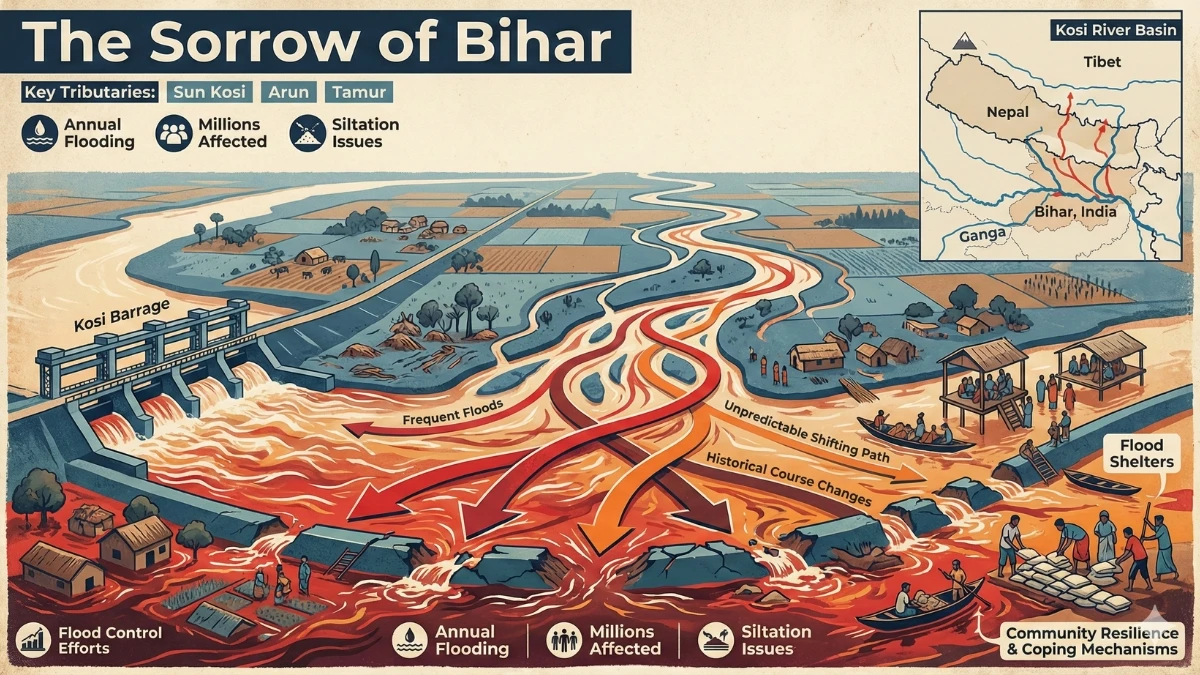
The river called the sorrow of Bihar is the Kosi River, because its frequent and unpredictable floods keep bringing loss to districts in north and northeast Bihar almost every monsoon.
For many families in Supaul, Saharsa, Madhepura, Araria and nearby areas, the word “Kosi” immediately brings a mix of respect and fear, since the same river that gives fertile soil can also wash away a year’s hard work overnight.
Older people in Kosi belt still tell stories of years when the river suddenly took a new path, and a whole village found itself on the wrong side of an embankment within one season.
Why Kosi’s Floods Are Still in the News?
Kosi’s floods are still in the news because even in recent years, heavy rain in Nepal and North Bihar has pushed the river above danger level and created flood-like situations in many districts.
In October 2025, for example, all 56 gates of the Kosi Barrage had to be opened as more than 5.33 lakh cusecs of water were released, leading to inundation in parts of Supaul, Madhepura, Saharsa and several panchayats in the region.
News channels have been reporting evacuation drives, NDRF and SDRF teams in boats, and community kitchens for displaced families, showing that Kosi floods are not just a chapter in history but a live issue even now.
A few common recent patterns keep Kosi in headlines:
-
Rivers like Kosi, Mahananda and Bagmati crossing danger marks after spells of heavy rain in the Terai region of Nepal and North Bihar.
-
Embankment breaches or pressure points that force quick repairs and, sometimes, emergency evacuations.
How Bihar is Trying to Live With Kosi?
Bihar is trying to live with Kosi by combining embankments, the Kosi Barrage, disaster response teams, and long-term planning for flood-prone areas instead of assuming the river can be fully “controlled.”
Embankments along Kosi and its tributaries, flood forecasting systems, and coordination with Nepal on water release are now regular parts of the state’s monsoon routine, even though no system is perfect when such a large river suddenly swells.
On the ground, life is a mix of adjustment and quiet courage:
-
Many families keep essential documents, school certificates, and some savings in plastic or metal trunks during monsoon, ready to move if the water rises at night.
-
In some villages, schools double as temporary flood shelters, and children grow up knowing boat routes as clearly as bus routes.
At the same time, there is a softer side: Kosi’s alluvial plains support fisheries and agriculture, and dried fish from the Kosi region is a regular product in local markets, reminding people that this “sorrow” is also a lifeline.
Where is Kosi Located?
The Kosi River is located in the eastern part of the Indo-Gangetic plains, flowing from the Himalayas in Tibet and Nepal into the plains of north Bihar before finally joining the Ganga near Kursela in Katihar district.
It is a transboundary river system: its upper tributaries rise on the northern slopes of the Himalayas in Tibet and Nepal, then meet in Nepal as the Saptakoshi, break through the Siwalik/Chatra Gorge, and spread out over the flat land of Bihar.
In plain words:
-
Origin region: Himalayan areas of Tibet and Nepal, with tributaries like Sun Kosi, Arun and Tamur.
-
India entry: Enters Bihar near Bhimnagar and then fans out across districts such as Supaul, Saharsa, Madhepura and Purnea before meeting the Ganga in Katihar.
This wide “fan” shape and heavy silt load are major reasons for its unstable course and frequent floods in Bihar.
When Did Kosi River Become Known as the Sorrow of Bihar?
Kosi river came to be known as the sorrow of Bihar over many decades, as repeated floods and dramatic course shifts across the last two to three centuries created a long memory of destruction in the region.
Historical records show that Kosi has shifted its main channel by about 120 km westward over roughly 250 years, and major flood events in the 19th and 20th centuries cemented the idea that this river brings both fertile soil and serious risk.
The label became even stronger after disasters like the 1954 floods and the 2008 Kosi barrage breach in Nepal, which affected more than 2.3 million people and submerged large parts of several districts in Bihar.
Disclaimer: This Information is a general overview of the Kosi River and its floods and should not be treated as official, legal, or emergency advice. For accurate, real-time information on weather, floods, or relief measures, rely only on government notifications and authorised disaster management agencies.